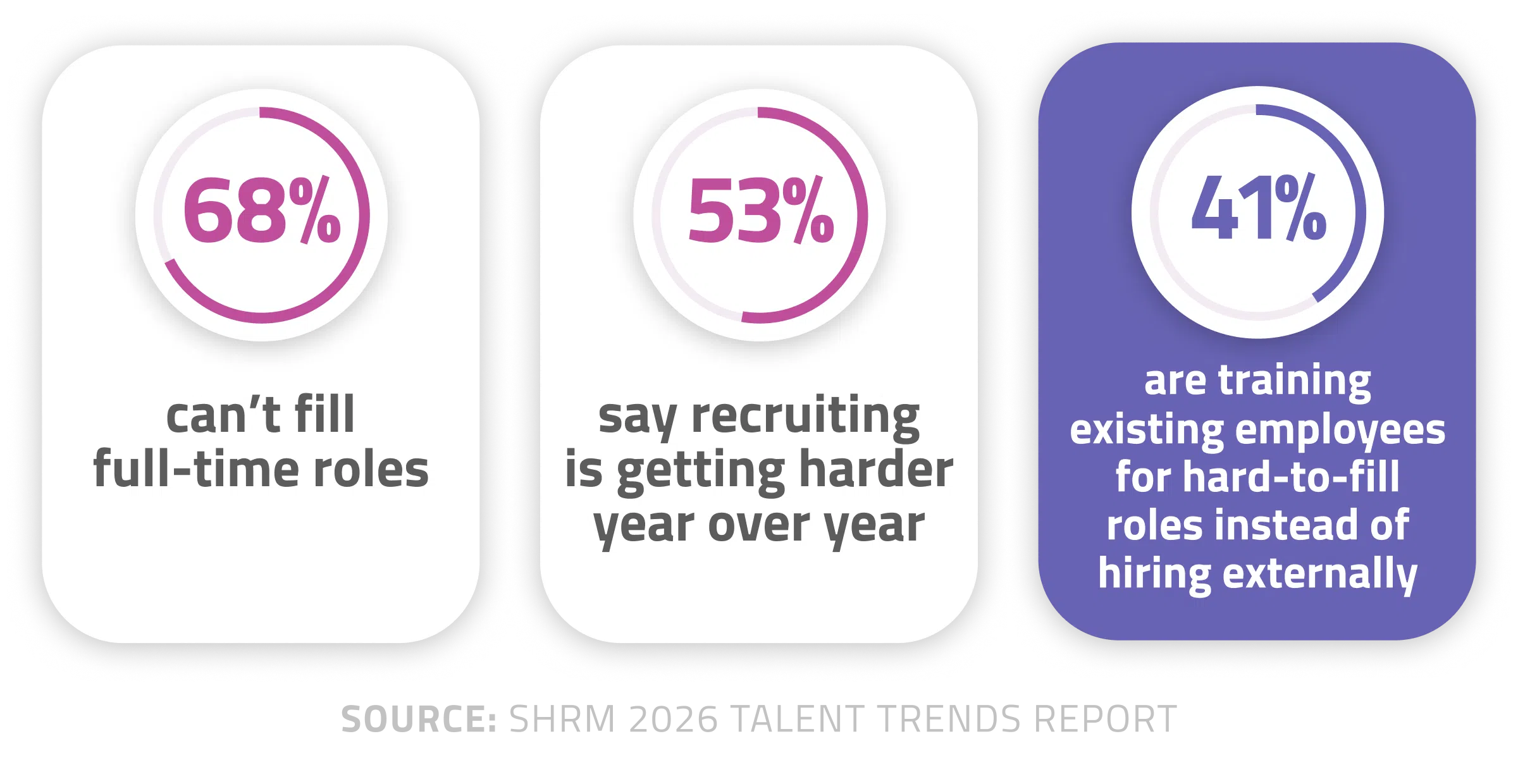
According to the SHRM 2026 Talent Trends Report, 68% of HR professionals still report difficulty filling full-time roles, and 53% say recruiting has become harder year over year.
The instinct when roles stay unfilled is to source more: more job boards, more agencies, a bigger pipeline. The assumption is that the problem is reach.
We’ve worked with organizations that had hundreds of applicants for a role and still struggled to hire successfully. The issue wasn’t candidate volume. It was figuring out which candidates were actually likely to succeed once they were on the job.
The conversations we’re having with employers today sound different than they did a few years ago. Fewer teams are asking how to attract more applicants. More are asking how to make better decisions with the candidates they already have.
One number points to a different problem: 41% of HR teams are now training existing employees for hard-to-fill roles rather than continuing to hire externally. That suggests many hiring challenges aren’t pipeline problems at all. They’re rooted in the candidate evaluation process and how organizations determine who is likely to succeed.
Why a Bigger Pipeline Doesn’t Solve a Hiring Quality Problem
When a role stays unfilled, expanding sourcing feels like action. If a structured hiring process struggles to identify likely success in 100 applications, adding hundreds more candidates rarely solves the underlying issue. A strong pipeline is important, but if the hiring process can’t consistently identify who is likely to succeed, adding more candidates often creates more work rather than better outcomes.
More applicants can actually make the problem harder to spot. When hiring teams are reviewing hundreds of resumes, it’s easy to assume the issue is sourcing when the real challenge is evaluating candidates consistently.
When evaluation criteria consistently miss the mark, the impact goes far beyond recruiting. Hiring managers spend time rehiring the same role. Onboarding resources get wasted on people who were never a real fit. Teams absorb productivity loss while vacancies remain open or new hires ramp up. And over time, high turnover in the same role stops being treated as a signal and starts being treated as normal. That is when the real cost becomes invisible.
What the Internal Training Shift Is Really Telling You
When nearly half of HR teams choose to build skills internally rather than continue hiring from outside, it signals that external candidates are consistently falling short. Not because qualified candidates don’t exist, but because the hiring criteria aren’t measuring whether someone can actually operate in the way the role demands.
Organizations absorb the cost of training because it often produces better outcomes than relying on an assessment approach built around credentials and years of experience. Those inputs are easy to screen for. They are weak predictors of whether someone will succeed in the actual demands of the role.
In many cases, internal training succeeds because organizations already understand what success looks like for their existing employees. They have far less clarity when evaluating someone they’ve never worked with before.
Why Resumes Don’t Tell the Whole Story
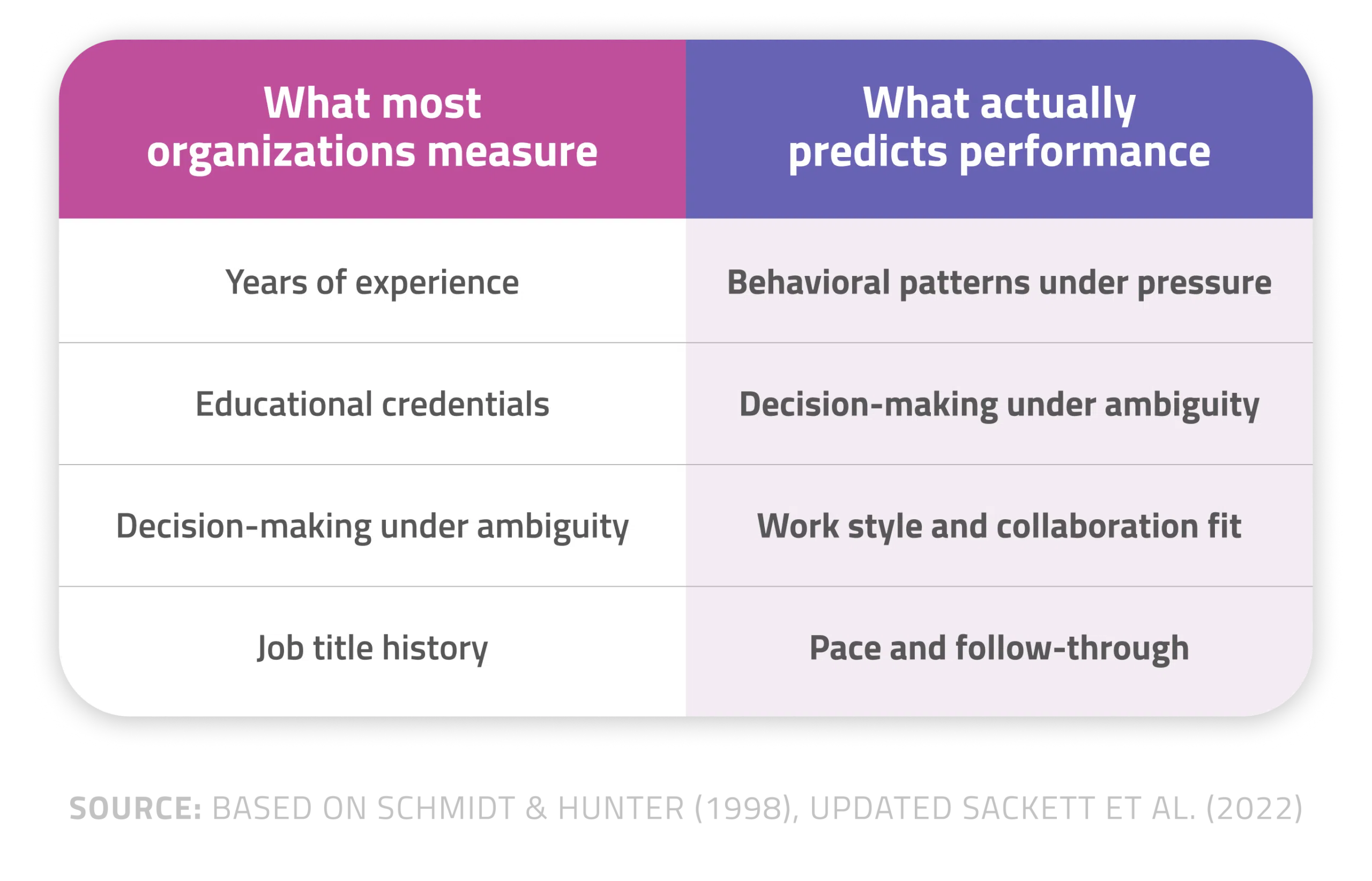
The gap between common screening practices and effective ones is not new. Schmidt and Hunter’s meta-analysis of 85 years of personnel selection research, and Sackett et al.’s 2022 reanalysis, both consistently show that resume credentials and years of experience are among the weakest predictors of on-the-job performance. Structured behavioral assessment and role-relevant work samples consistently outperform credential-based screening when predicting job performance.
Most organizations screen for what’s easiest to see: years of experience, educational background, and prior job titles. Those factors provide useful context, but they don’t always explain why one person succeeds while another struggles in the exact same role.
What often goes unmeasured are the behaviors that determine whether someone can succeed in your specific environment.
We see this challenge frequently when organizations try to define what makes their top performers successful. Most teams can quickly identify who their strongest performers are. What’s harder is identifying what those people have in common.
Expert Insight
“Organizations with hiring issues often can’t clearly articulate the behaviors and aptitudes that are driving success in the role. They can describe their high performers, and that’s a great start, but the “active ingredients” that are actually driving performance are often not the most obvious.
Much like two cars can look nearly identical from the outside but perform very differently under the hood, top performers may appear similar on the surface while succeeding for different reasons. To predict success, you need to identify the underlying characteristics that truly drive performance.“
Craig Ellis, Ph.D., and Rob Loy, Ph.D.
HighMatch I/O Psychologists
How to Evaluate Candidates Against What the Role Actually Requires
Rebuilding hiring criteria starts with what the role actually demands, not the credentials of the last person who held it.
Most job descriptions default to credential proxies that describe the resume of someone who once succeeded, not the behaviors that made them succeed.
A logistics dispatcher role might list industry experience as a requirement when the real performance driver is how quickly someone reprioritizes competing demands under pressure. A manufacturing supervisor role might emphasize tenure when what actually separates strong performers is the ability to hold standards consistently while maintaining team trust. The credentials looked similar. The behavioral patterns didn’t.
Three changes to the selection criteria produce the most consistent improvement:
1. Assess behavioral patterns relevant to the role
The behaviors that matter vary: decision-making speed, ambiguity tolerance, collaboration style, pace, follow-through under pressure.
A successful dispatcher, restaurant manager, sales leader, and manufacturing supervisor may all require very different strengths. The most effective hiring processes measure the behaviors that drive success in that particular environment rather than relying on a generic definition of fit.
This level of precision leads to better hiring outcomes and a more consistent candidate experience.
2. Pair structured interviews with behavioral assessment
Most interviews fail not because the format is wrong but because they lack structure, defined criteria, and a clear connection to what the role actually demands.
Behavioral assessments shouldn’t replace interviews. They should strengthen them.
A well-designed interview measures how someone thinks and communicates under real conditions. Behavioral assessment measures the underlying patterns that drive whether they’ll succeed in this specific environment. Together they close the gap that either alone leaves open.
3. Build assessment criteria from your top performers, not job descriptions
The most reliable foundation for a candidate evaluation process is the people already succeeding in the role.
Compare what they actually do: how they make decisions, how they handle competing priorities, what conditions they need to perform well.
In our experience, organizations tend to make stronger hiring decisions when they build criteria around what their strongest performers actually do rather than relying solely on generic qualifications.
The Hiring Problem Is Fit Definition, Not Pipeline Size
Hard-to-fill roles do not always require a bigger pipeline. They often require a clearer definition of what success in the role actually looks like.
When 41% of HR teams are training internally because external hiring keeps producing the wrong outcomes, and when decades of research confirm that the most common screening criteria have low predictive validity, the conclusion is the same: the problem is not that qualified candidates don’t exist. The evaluation process can’t identify them.
That shift starts with clearly defining what success looks like in the role and building the evaluation process around those expectations.
Because filling the role is only the first step. The real goal is hiring someone who will succeed once they’re there.
FAQ
A candidate evaluation process is how an organization determines which applicants are most likely to succeed in a role. It can include resume screening, interviews, behavioral assessments, work samples, and other selection steps. When the process is unclear or inconsistent, adding more applicants usually creates more volume, not better hiring decisions.
A bigger pipeline only helps if the hiring process can accurately identify which candidates are likely to succeed. If the evaluation criteria are weak or inconsistent, more applicants simply create more resumes to review. SHRM’s 2026 Talent Trends Report found that 68% of HR professionals still report difficulty filling roles, which points to evaluation as much as sourcing.
Resumes, job titles, and years of experience can provide useful context, but they are limited predictors of job performance. Personnel selection research, including Schmidt and Hunter’s meta-analysis and Sackett et al.’s 2022 reanalysis, has found that structured behavioral assessment and role-relevant work samples are stronger predictors than credentials alone.
Companies can improve candidate evaluation by defining what success actually looks like in the role, assessing behavioral patterns tied to that success, and using structured interviews alongside behavioral assessment. The strongest criteria usually come from understanding what current top performers do differently, not just copying qualifications from a job description.
About HighMatch
At HighMatch, we partner with organizations to understand what success looks like in their roles before candidates ever enter the hiring process. Our assessments are built around the behaviors, capabilities, and work styles that drive performance in each environment, helping teams make more confident hiring decisions and create a more consistent selection process.